
Nothing for Us Without Us – Exploring inclusive design at the National Neurodiversity show
Last week Vidatec spent the day at the National Neurodiversity Show in Glasgow, a one-day event bringing together neurodivergent individuals, carers, educators and vendors around accessibility and assistive technology. We went with a specific brief: what could we learn that’s actually useful for the products we build. We came away with lots of inspiration and new considerations, but two things stood out in particular.
“Nothing for us, without us”
It’s a phrase with a long history in disability and accessibility activism, dating back to the early 90s. What struck us wasn’t hearing it said; it was seeing it built. Almost every product or service on show had been conceptualised by neurodivergent people themselves, solving problems they’d faced first-hand.
Scottish Autism made the same point from a different angle, institutional rather than product-led. Their Advisory Panel was established specifically so autistic people actively guide the organisation’s governance, services, and campaigns. We heard from a member of the panel, who spoke about what thatmeant in practice, describing the experience as revolutionary, both for her personally and in seeing the wider organisation listen to, and act on, the community’s input.
Across the seminars and vendors, the benefits of designing for neurodivergence first, and involving the community in building the solution, were clear: things produced this way worked better for everyone.
Designing for accessibility first benefits all
Brain in Hand gave one of the best examples, and their own product framing was: designed for neurodivergence, built for everyone.
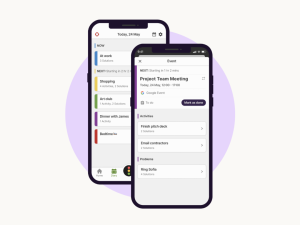
Image Credit: Thriver
Their app combines in-person coaching with self-serve features, and no formal diagnosis is required to access the service, allowing it to branch into wider mental health support.
That ethos can be found throughout their product design:
Onboarding – asks what someone wants support with and what kind of content they respond to (videos, articles, short activities), then adapts around that, rather than assuming what format works.
Check-in – pairs a mood rating with tags and free text, turning a vague “Not Ok” into something actionable and able to surface relevant resources. By viewing a visual timeline of check-in data, users can learn their own patterns and triggers over time.
Calendar integration – syncs across work and personal accounts. Individual entries can have their own coping strategy or reminder attached to them. The integration is one-way, but it means entries don’t need to be manually duplicated across multiple systems.
None of these features need a medical diagnosis to be useful. That’s the trick. Features built for a specific, often invisible need turn out to be exactly what most workplaces are missing for everyone else too.
The same logic could easily be applied to some of the wider psychological coping tools mentioned throughout the day.
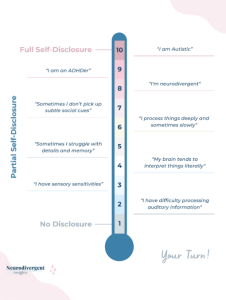
The self-disclosure thermometer (link), normally used to reflect on what you’re comfortable sharing, could be repurposed at the task level instead. Rather than asking “how open do I want to be”, the scale becomes “how does this task affect me today, attaching the emotion to the thing, not the person, so support can adjust automatically for that situation without judgement.
Source: Neurodivergent Insights
The Autistic burnout checklist (link), though built for neurodivergent users, has many flags that fall within standard Maslach-style territory and can apply to anyone. Even the sensory items, which are more ND-specific, aren’t exclusive to neurodivergent brains. We can reframe this approach as a general burnout self-check, generating a visual personal pattern over time rather than being a diagnostic tool.
The life-stage gap
The third thing that stuck with us was less a positive finding and more a gap. Across several Q&As, the same question kept coming up, asked by neurodivergent attendees, carers and practitioners alike: how does this solution follow someone across their whole life? For most of what was on show, the honest answer was, it doesn’t. Products built for school don’t survive the transition to university or work. Once someone leaves the environment a tool was designed for, they either lose access outright or keep using it in ways it was never built to support.
That’s not a criticism of any one product. It’s a genuine, unaddressed gap in the market, and one that’s easy to miss if you’re only ever evaluating a tool against the moment it was designed for, rather than the life it’s actually going to sit inside.
Why all this matters
The throughline for Vidatec is this: supporting neurodivergent people well isn’t a niche design consideration you bolt on afterwards. Done properly, from the start, it tends to produce something better for everyone who uses it – and it forces you to ask harder, more honest questions about longevity, not just features. Both of those are lessons worth carrying into any product conversation, not just ones explicitly about accessibility.
Move from AI Chaos to AI Clarity
If your organisation is experiencing fragmented pilots, unclear boundaries, regulatory anxiety or difficulty scaling beyond experimentation, it is time to move from chaos to clarity. Download the whitepaper and take the first structured step toward building AI systems that work
Take the Next Step to Delivering a Better Employee Experience Through AI with Vidatec

Learn More About our AI Consulting Services
We cut through the AI hype to help you understand what actually works in your specific situation. Drawing from 300+ real-world projects, we help you implement AI in simple, practical steps that actually stick and deliver results.
Watch our 30-Minute Expert-Led AI Webinar
Hear directly from our CEO, Ross Wilson, and CTO, Nick Welch, as they provide a framework to assess your organisation’s AI readiness and outline practical tools and strategies to implement a true human-first AI implementation.
Read More of Our Latest Insights on AI and Employee Experience
Want more practical insights from our tech team? We regularly share real-world lessons from building AI solutions, developing apps, helping businesses transform digitally, and tackling challenges across different industries.



Meet the author